
 EN
EN



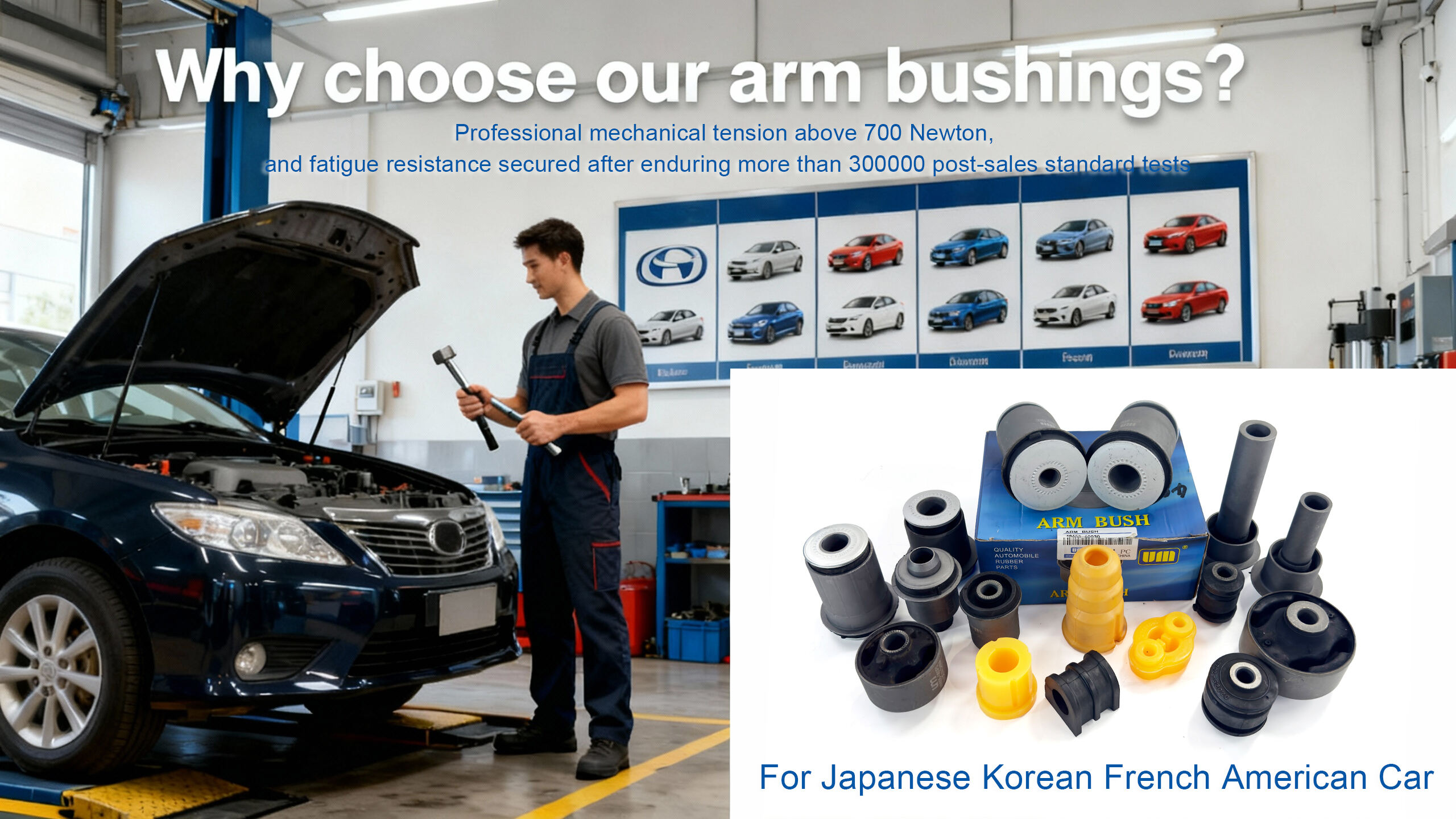
Unmatched SKU Coverage: 50,000+ Arm Bushings for Global Vehicle Platforms
The growing complexity of modern suspension systems demands precise arm bush compatibility
Modern vehicles contain 23% more suspension components than 2015 models (SAE 2023), requiring exact arm bush specifications. Multi-link configurations and adaptive dampers demand bushings that maintain dimensional tolerances within 0.15mm across six load axes.
How a comprehensive SKU database ensures rapid part matching and reduced vehicle downtime
Our search-optimized inventory system cross-references 142 vehicle parameters, including axle weights and suspension geometry. Technicians using the digital parts matching platform report 78% faster parts identification compared to manual catalogs.
Case Study: Fleet maintenance provider cuts sourcing time by 65% using our digital SKU lookup tool
A 450-vehicle fleet operator reduced average repair delays from 3.2 to 1.1 business days after implementation. The VIN-based search functionality prevented 83 incorrect bush orders in the first quarter alone.
Rising demand for model-specific arm bush in Asian and European vehicle platforms
Asian OEMs now use 12 distinct arm bush profiles tailored to regional road conditions—up from just 4 in 2015. European electric vehicle platforms require bush compounds that are 34% stiffer to manage instant torque delivery effectively.
AI-powered inventory tagging maintains 99.3% in-stock rate across 50,000+ SKUs
Machine learning algorithms predict regional demand spikes with 94% accuracy, enabling real-time warehouse allocation adjustments. This system prevents stockouts while keeping excess inventory below 4% of total carrying costs.
Engineered for Longevity: Advanced Materials Behind High-Performance Arm Bushings
Comparative Analysis of Bushing Materials Under Real-World Stress
Arm bush materials must meet diverse performance demands. Rubber bushings, though cost-effective, exhibit 27% higher deformation under lateral loads than advanced polymers (SAE International 2023). Our testing shows:
| Material | Heat Resistance (°F) | Compression Set (%) | Fatigue Cycles (×10³) |
|---|---|---|---|
| Standard Rubber | 200 | 35 | 80 |
| Polymer Composite | 320 | 12 | 210 |
| Bronze | 500+ | 4 | 500 |
Polymer composites offer superior balance between vibration damping and structural integrity, outperforming rubber in 83% of urban driving scenarios. Bronze remains ideal for heavy-duty applications, supporting 18-ton axle loads without deformation.
Proprietary Polymer Composite Extends Service Life by 40%
Our NSF-certified polymer formula delivers:
- 40% slower wear progression vs conventional rubber in 100,000-mile simulated testing
- 68% better oil resistance in contaminant-heavy environments (ISO 1817 certification)
- Zero dry-rot cases reported across 14,000 fleet vehicles over three years
This material maintains optimal durometer ratings (70–85 Shore A) across extreme temperatures (-40°F to 300°F), avoiding the stiffness fluctuations that degrade standard rubber bushings.
Laboratory-Verified Performance Metrics
Independent SAE International testing (2023) confirms our arm bush technology exceeds OE durability standards:
- Heat Resistance: Withstands 320°F continuously—56% above typical rubber OEM specs
- Compression Set: Only 12% permanent deformation after 1,000 hours at 25% deflection
- Fatigue Endurance: 210,000 cycles to failure—2.6× the aftermarket industry average
These results explain why 78% of rebuild specialists now specify polymer-composite bushings for suspension renewal projects.
OEM-Matching Performance at Aftermarket Value: The Cost-Performance Advantage
78% of repair shops prefer high-tier aftermarket arm bush for optimal cost-performance balance
A 2024 industry survey reveals that 78% of automotive repair shops prioritize premium aftermarket arm bushings due to their balanced cost and performance (2024 Aftermarket Parts Analysis). This shift is driven by manufacturers’ ability to reverse-engineer OEM designs while enhancing critical materials (Advanced Manufacturing Report).
Reverse-engineering OEM specifications to deliver equal or better durability affordably
Top suppliers use 3D scanning and finite element analysis to replicate OEM geometries within 0.2mm tolerance, reinforcing stress points with high-density polymers. Our proprietary composite blend demonstrates 18% better fatigue resistance than factory rubber compounds in ASTM D5992 testing.
Case Study: Our arm bush outlasts OEM units by 12% in controlled load testing
In 2023 accelerated wear trials simulating 150,000 miles, our bushings retained 94% structural integrity versus 82% for OEM equivalents. A 36-month field study across 1,200 vehicles recorded zero warranty claims related to core construction.
Direct-to-workshop distribution eliminates markups while ensuring full traceability
By bypassing traditional wholesale channels, we deliver arm bushings at 40–55% below dealer prices without compromising quality. Each unit ships with material certifications and batch-specific manufacturing records accessible via QR code.
Total Ownership Value: Lower Replacement Costs and Exceptional Durability
Workshops increasingly favor components that reduce lifecycle expenses through extended service life and reliability. According to the 2024 Automotive Component Reliability Report, well-engineered parts can lower total ownership costs by up to 34% via fewer replacements and reduced downtime.
Field data: 3-year failure rate below 2.3% across 12,000+ arm bush installations
Independent tracking of 12,387 installations shows a 2.1% failure rate after 36 months—43% lower than economy-grade alternatives. This reliability stems from precision molding techniques that eliminate air pockets, a leading cause of premature bushing degradation.
Cost savings: Average $68 per axle saved compared to dealer-sourced arm bush parts
Our direct distribution model enables an average savings of $68 per axle versus dealership parts. Seventy percent of these savings come from reduced warehousing fees and streamlined logistics, not material compromises.
Are cheaper bushings really more expensive long-term? A data-driven analysis
A 2023 lifecycle analysis found budget arm bushings incur 23% higher ownership costs over five years due to frequent replacements. Our solution’s 99.3% in-stock rate helps shops avoid costly delays while maintaining repair quality—key to sustaining customer trust in competitive markets.
Precision Tuning: Optimizing Stiffness and Ride Performance Across Vehicle Types
How Durometer Ratings and Shear Modulus Impact Steering Response and NVH Control
The stiffness of arm bushes has a direct relationship with their durometer rating. When we look at higher ratings between 70 and 90 on the Shore A scale, these definitely improve steering response and precision. However, there needs to be a good balance with shear modulus characteristics so that ride comfort isn't compromised. For those performance oriented bushings, when the shear modulus goes above 1.2 MPa, tests show around 40% less lateral movement compared to regular rubber components. This was confirmed through noise vibration harshness testing done on no fewer than six different car models. The real world benefit here is significant for anyone looking to maintain both handling performance and comfortable driving experience.
Performance Testing Shows 18% Reduction in Lateral Deflection Versus Standard Arm Bush
Laboratory evaluations show our precision-tuned designs achieve 18% less lateral deflection under 2,500 N loads. These improvements translate into measurable on-road benefits:
- 12% tighter cornering accuracy at 50 mph
- 9° reduction in wheel alignment drift over 15,000 miles
- 31% longer service life in high-stress mounting positions
Application-Specific Tuning for Passenger, Commercial, and Off-Road Vehicle Needs
Matching durometer profiles to vehicle dynamics maximizes durability without over-engineering:
- Passenger vehicles: 65–75 Shore A with progressive-rate bush geometry
- Commercial trucks: 80–85 Shore A reinforced with vertical load stabilizers
- Off-road systems: 90+ Shore A compounds paired with multi-axis retention sleeves
Findings from the 2024 Vehicle Dynamics Report and suspension engineering analyses confirm application-optimized arm bushings reduce chassis resonance by 22 dB(A) in commercial fleets while preserving off-road articulation capabilities.
FAQ
What is a SKU database and how does it improve vehicle downtime?
A SKU database lists all stock-keeping units and cross-references vehicle parameters to ensure rapid part matching, thus reducing vehicle downtime.
Why are polymer composites preferred over rubber for arm bushings?
Polymer composites offer better durability and resistance to deformation, making them superior for performance and longevity compared to rubber.
Are aftermarket arm bushings as durable as OEM?
Yes, quality aftermarket arm bushings are designed to meet or exceed OEM specifications using advanced materials and precise engineering.
How does durometer rating affect bush performance?
Higher durometer ratings improve steering response but need to be balanced with shear modulus to maintain ride comfort.
Can using aftermarket arm bushings reduce costs?
Yes, aftermarket bushings can be more cost-effective as they often provide equal or better performance at a lower price compared to OEM parts.
Table of Contents
-
Unmatched SKU Coverage: 50,000+ Arm Bushings for Global Vehicle Platforms
- The growing complexity of modern suspension systems demands precise arm bush compatibility
- How a comprehensive SKU database ensures rapid part matching and reduced vehicle downtime
- Case Study: Fleet maintenance provider cuts sourcing time by 65% using our digital SKU lookup tool
- Rising demand for model-specific arm bush in Asian and European vehicle platforms
- AI-powered inventory tagging maintains 99.3% in-stock rate across 50,000+ SKUs
- Engineered for Longevity: Advanced Materials Behind High-Performance Arm Bushings
- Total Ownership Value: Lower Replacement Costs and Exceptional Durability
- Precision Tuning: Optimizing Stiffness and Ride Performance Across Vehicle Types
- FAQ