
 EN
EN



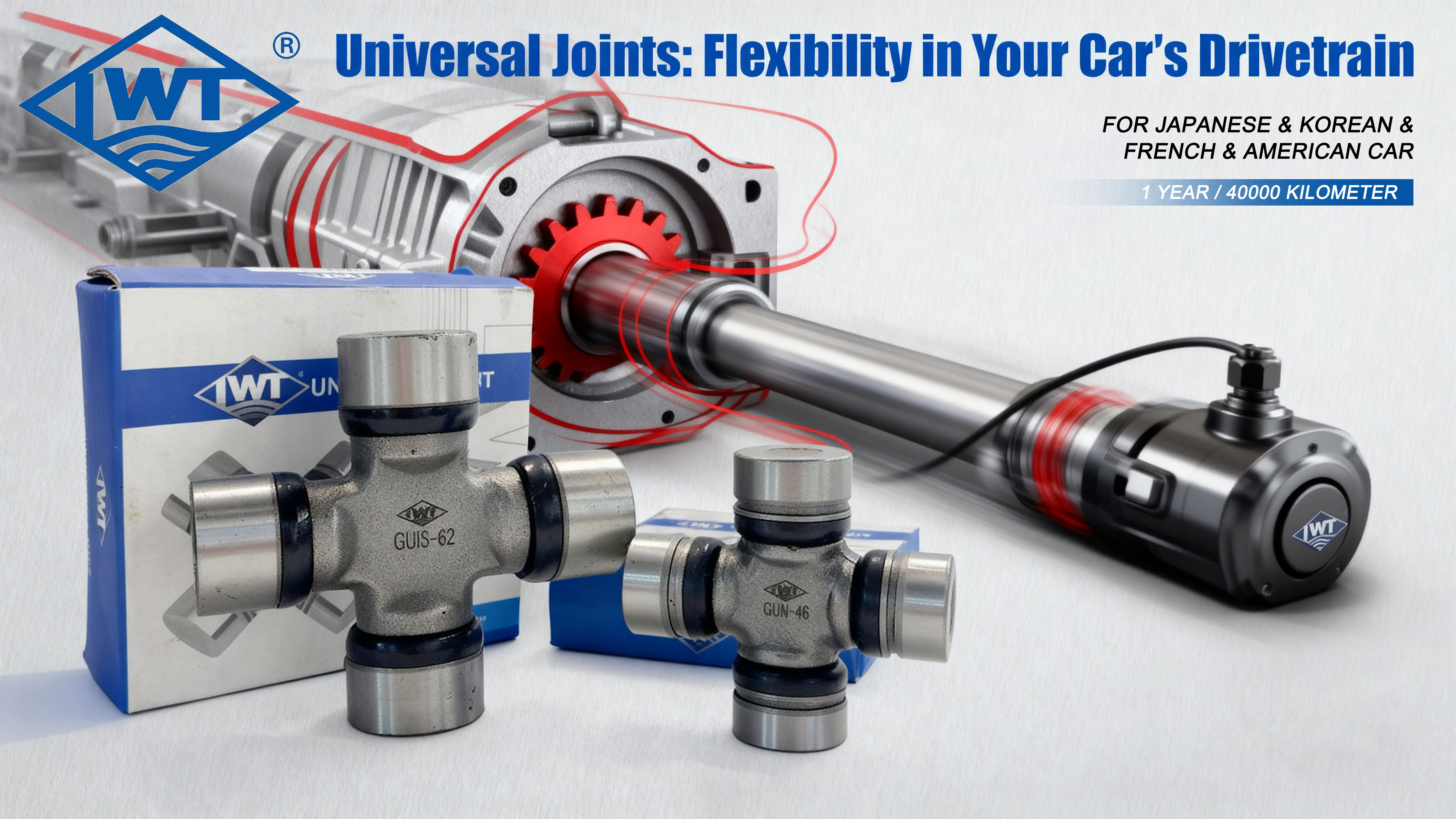
What Is a Universal Joint and How Does It Work?
Definition and Basic Structure of Universal Joints
The universal joint, commonly called a U-joint, serves as a mechanical connector between rotating shafts and allows for some degree of angular misalignment. At its heart lies a cross-shaped assembly containing four needle roller bearings, along with two yokes and four trunnions. Typically, one end connects to something like a transmission's output shaft, while the other end links up to whatever driveshaft component needs power transfer. For over a hundred years now, this particular cross and bearing setup has remained a staple in car drivetrains because it can handle pretty rough conditions without breaking down and still manages to pass along torque effectively even when things get bumpy on the road.
Core Function: Transmitting Rotational Power at Variable Angles
U-joints basically do one main thing: they pass rotational force between shafts that aren't lined up straight but instead form angles of up to about 45 degrees. What makes them different from those stiff rigid couplings is how they handle when things get out of alignment because of bumps in the road or when the car body twists and bends. This flexibility means power keeps flowing from the transmission all the way to the wheels without interruption, which matters a lot when driving on rough roads or taking sharp turns at speed. Without this feature, vehicles would struggle to maintain power transfer through normal driving conditions.
How U-Joints Enable Driveshaft Flexibility and Angular Movement
When dealing with live axle setups, universal joints play a key role by letting the driveshaft bend when the suspension moves up and down. Take off road trucks for instance they typically install several U joints along the prop shaft so power can keep flowing even when the truck is going over rough terrain and the wheels move independently. What makes these joints really useful is how they adjust themselves automatically when force is applied, which takes pressure off other parts like transfer cases and differential assemblies that would otherwise suffer from excessive wear and tear.
Types of Universal Joints and Their Automotive Applications
Cross and Bearing U-Joints: The Standard Driveshaft Solution
Cross and bearing U joints still dominate the market as the go to design choice for many applications. These joints feature a four point cross assembly with needle roller bearings built in. They can handle angular movement angles up to around 30 degrees, which is why they show up so commonly in traditional rear wheel drive cars on the road today. According to recent industry reports, about 8 out of 10 light duty trucks actually have these types installed in their drive shaft systems. But watch out when things get misaligned past roughly 15 degrees because vibrations start getting really noticeable then. This means mechanics need to be extra careful during installation to ensure everything lines up properly from day one.
Double Cardan and Constant Velocity (CV) Joint Variants
Double Cardan joints basically combine two universal joints connected by what's called a centering yoke. This setup cuts down on those annoying vibrations during operation by around 40 percent when compared to older single joint systems used in four wheel drive cars. Then there are these Constant Velocity or CV joints that keep things spinning at the same rate even when angles change quite a bit, sometimes as much as 47 degrees. That makes them really good for front wheel drive axles where space is tight. We're seeing more and more all wheel drive models going with CV joints lately because they transmit power through those tricky angles about 30 percent better than other options. Manufacturers love this since it means smoother rides and fewer complaints from customers about strange noises coming from under the hood.
Standard vs. Heavy-Duty Universal Joints: Use Cases Compared
| Feature | Standard U-Joints | Heavy-Duty U-Joints |
|---|---|---|
| Material | Case-hardened steel | Forged chromoly alloy |
| Load Capacity | ₤ 450 lb-ft torque | ₤ 800 lb-ft torque |
| Common Applications | Passenger vehicle drivetrains | Off-road trucks, towing systems |
Field testing shows heavy-duty variants endure 2.3 times more stress cycles in rock-crawling scenarios than standard models, highlighting their superiority in high-torque, off-road environments.
Applications in Propeller Shafts, Transfer Cases, and Off-Road Systems
Universal joints are essential across several drivetrain applications:
- Propeller shafts: 70% of commercial trucks use dual U-joint configurations for tandem axle power transfer
- Transfer cases: Sequential beats spools for on demand 4WD control
- Off-road systems: Articulated joints allow for greater axle flexibility (+28% more articulation) in modified crawlers compared to stock setups
Design, Materials, and Engineering of Durable Universal Joints
Key Components and Their Functions
When dissecting a universal joint, we notice it consists of several vital parts: yokes, trunnion, roller bearings, and snap rings. Each item plays a role when transferring rotational force from input to output ends and creating room for random movements in between. Without these parts working seamlessly together, drivetrains wouldn't survive road stresses nearly as well when the vehicle encounters inclines, declines, speed bumps, and dips while picking up speed.
High-Performance Alloys and Materials
Makers of top notch universal joints rely on high carbon steels and inverter grade alloys to achieve lightweight designs without compromising strength. Recent advances in material science make it way easier than ever before to integrate corrosion protection right into the compound instead of relying exclusively on coatings. The payoff here involves less maintenance over time because those exposed edges won't need constant treatment, and they don't fracture easily under severe conditions either.
Greasing Techniques and Best Practices
For longevity, make sure you lubricate U-joints at least twice annually and ideally after each oil change. Use heavy-duty grease that can endure extreme pressure conditions without breaking down. Engineers recommend greases that meet NLGI 2 specifications, including molybdenum disulfide or synthetic-based variations, for trucks and off-road vehicles. Insider sources say some of the best products for really gnarly environments also offer resistance against water washout, corrosion, thermal breakdown, and oxidation.
Choosing the Right Universal Joint for Your Vehicle
Matching U-Joints with Vehicle Purpose and Usage
Picking the correct universal joint requires evaluating what the vehicle will face out on the road each day. Is it going to be a family van seeing little more excitement than hauling groceries, or are we talking about highly customized off-highway beasts built for trailblazing? For the former category, having a decent standard U joint should usually do the trick and last thousands upon thousands worth of trouble free miles. On the flip side, if you're working with a monster 4 x4 meant to take on gnarly terrains where typical loading and shifting would simply overwhelm ordinary components then something heavier duty might provide better value and performance in terms of longevity under stress.
Understanding Installation Challenges and Misalignment Risks
Getting U-joints installed right requires specific expertise – this isn't an area car owners should cut corners simply because do overs cost serious cash down the line both literally plus it being really inconvenient too especially if failures come unexpectedly when miles away from help or when in the middle of nowhere like an empty desert highway. Installing them at the wrong angles usually leads to negative results such as reduced fuel efficiency, excessive power loss, shortened durability, and worsened road handling. Keeping everything calibrated carefully ensures a better performing vehicle overall.
By focusing on precision and scheduling routine checks, experienced mechanics often prevent worsening wear and gradual failure. These inspections involve noting unusual squeaks, clicks, or thuds as well as tactile assessments concerning vibrations that travel through control linkages and foot pedals during squirts of gas or sudden braking at speed.
Future Innovations: Enhancements in U-Joint Design and Material Science
The evolution of universal joints doesn’t stop here. Advanced control theories coupled with cutting edge sensor systems promise even greater precision and adaptability in delivering power smoothly across complex geometries. Labs and companies worldwide are researching materials science breakthroughs like metallic glasses and carbon nanotube reinforcements to make these parts lighter but tougher still. Given the rapid pace of improvement demonstrated since the early twentieth century, it's clear universal joints aren't going away anytime soon, particularly as drivetrains advance and become more efficient and versatile than we could ever predict.
Impact of Manufacturing Processes Like Laser-Cutting and High-Precision Cooling
At the heart of modern universal joint production lies cutting-edge technology designed to achieve peak mechanical properties with minimal waste. Laser cutting, for example, yields precisely machined yokes with uniform dimensions, enhancing lifespan and torque distribution across the joint. Advanced heat treatment cycles ensure metal alloys have optimal hardness properties to endure continued mechanical strain over time.
Quality Standards and Testing Procedures
Leading manufacturers follow international standards organizations like ISO and ANSI guidelines to meet industry specific requirements regarding universal joints performance. Since precision machining and testing lead directly to more dependable long term product outcomes, professionals recommend seeking certifications including Tier 1 automotive supplier status whenever possible. Verifying rotations per minute capabilities as well as maximum supported loads under real world conditions also prevents costly warranty claims downstream by customers. On top of this, aerospace grade inspection protocols check each piece of raw material through every stage of production therefore ensuring premium quality assurance across various industries where reliability remains crucial.
The Future of Universal Joint Technology: Emerging Trends
Several developments hold promise for tomorrow's next generation products. Take non metallic substitutes for example polymer engineering combined with carbon fiber makes for lighter load carrying capacities at decreased cost. Meanwhile, advances like active smart actuators made possible by microelectronics enable real time adjustment under variable stress conditions. At the other end of the spectrum is “smart” predictive analytics that monitor performance metrics in live systems in order to project essential upkeep needs upfront while collecting intention real valuable data points engineering teams increasingly depend upon. The future holds innumerable possibilities as researchers continue to push boundaries on innovation within complex integrated systems.
Concluding Insights on the Versatile Engineering of Universal Joints
In sum, the universal joint has remained an essential power transfer device throughout history, largely because of its capability to handle variable angular movements and challenging terrain conditions. Whether functioning as key elements within propeller shafts and steering columns atop a mountain range, or silently absorbing vibrations across urban roads, these simple machines achieve a remarkable balance between versatility and durability under harsh conditions without sacrificing performance.
FAQ Section
What is a universal joint?
A universal joint, or U-joint, is a mechanical connector that allows for angular misalignment between two rotating shafts, commonly used in vehicle drivetrains to transmit torque efficiently despite road conditions.
How do U-joints work?
U-joints transmit rotational force between misaligned shafts by allowing movement and rotation at an angle, helping maintain a continuous flow of power especially during rough driving conditions.
What are the types of universal joints?
The main types of universal joints are cross and bearing U-joints, which handle up to 30-degree angle movements, and double Cardan or constant velocity joints, which manage larger angles up to 47 degrees.
When should I replace my universal joints?
Regular inspections are recommended, and you should measure the radial play of the joints. If there is movement exceeding 0.030", it is time to replace the U-joints, especially in case of heat spikes or clunking noises during operation.
Table of Contents
- What Is a Universal Joint and How Does It Work?
- Types of Universal Joints and Their Automotive Applications
- Design, Materials, and Engineering of Durable Universal Joints
-
Choosing the Right Universal Joint for Your Vehicle
- Matching U-Joints with Vehicle Purpose and Usage
- Understanding Installation Challenges and Misalignment Risks
- Future Innovations: Enhancements in U-Joint Design and Material Science
- Impact of Manufacturing Processes Like Laser-Cutting and High-Precision Cooling
- Quality Standards and Testing Procedures
- The Future of Universal Joint Technology: Emerging Trends
- Concluding Insights on the Versatile Engineering of Universal Joints
- FAQ Section